- Published on
I started Prodigal's Chair with a few goals in mind. I wanted to write, and to find an outlet for my output, but more importantly, I wanted to create a space. As many of the pieces I've placed in these pages indicate, my life was shaped by my participation in and eventual break from a fundamentalist Christian church during my teenage years. With PC, I wanted to take the best of what that experience offered me -- acceptance, a chance to grow and feel loved for who you are -- without the strings that are attached to that kind of "freedom." I wanted to let people of all points of view and experience have their voices heard on a broad range of abstract and concrete topics.
And for a while, I fucking killed it. I won't bullet point the ways; anyone who's interested can look at the "PAST ISSUES" section to see who's been represented and what's been accomplished. PC has managed to bring together a fairly disparate group of peoples -- some writers, many not.
I am very proud of that.
But it's been a one man show, I do all of the artwork, editing, layout, etc., and to do PC right means giving it more time and attention than I currently can. For those who don't know me up close and personal-like, I'm a public school teacher who has headed back to grad school for more punishment. And I want my wife to see me from time to time, too.
So I'll be pushing in my chair for a bit. Prodigal's Chair is not ending outright, nor is it going completely dark. But you won't see any new issues for a while. There will be a few dispatches from time to time as the spirit moves, and when that happens I'll let you know through all of the usual channels.
Until then...
And for a while, I fucking killed it. I won't bullet point the ways; anyone who's interested can look at the "PAST ISSUES" section to see who's been represented and what's been accomplished. PC has managed to bring together a fairly disparate group of peoples -- some writers, many not.
I am very proud of that.
But it's been a one man show, I do all of the artwork, editing, layout, etc., and to do PC right means giving it more time and attention than I currently can. For those who don't know me up close and personal-like, I'm a public school teacher who has headed back to grad school for more punishment. And I want my wife to see me from time to time, too.
So I'll be pushing in my chair for a bit. Prodigal's Chair is not ending outright, nor is it going completely dark. But you won't see any new issues for a while. There will be a few dispatches from time to time as the spirit moves, and when that happens I'll let you know through all of the usual channels.
Until then...
- Published on

MSD Student Emma Gonzalez speaking at the Broward County Federal Courthouse on Feb. 17. Original photo by R. Wise/AFP/Getty Images remixed by T. Guzzio
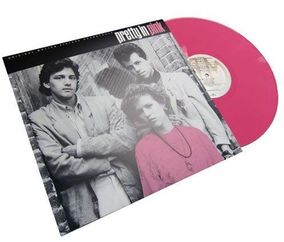
For this Valentine’s Day my wife and I got my fourteen-year old daughter a pair of hot pink patent leather Doc Marten boots I found at a local thrift store, the Pretty in Pink soundtrack in 180 gram pink vinyl, a black David Bowie “Starman” t-shirt with pink and blue accents, and some pink-foil wrapped dark chocolate hearts. In Parkland, Florida, the students and staff of Marjory Stoneman Douglas High School and their families got something else.
I’m sure Valentine’s Day will mean something drastically different for the MSD community from now on in ways that I can’t fully imagine. But as these students and their families work their way towards some new normalcy, they are simultaneously leading their childish elected officials kicking and screaming towards a more reasonable, responsible relationship with guns in America. Teenagers who huddled behind desks and hid in closets are standing up in the name of the seventeen students and staff who won’t be around next Valentine’s Day, and they’re challenging perceptions about what their Tide Pod eating generation is capable of.
That these kids are more resolute and reliable than the people their parents elected to lead them was painfully clear to anyone who saw the Florida legislature refuse to open a gun measure up for a floor debate shortly after the shooting. Yet on that same day - with many MSD students in the gallery - they defined pornography as a public health risk. Regardless of your opinion on pornography, as a teacher, I can tell you that I’ve never worked at, nor have I heard of, any school being locked down because someone brought a Hustler into the building.
The brilliance of the MSD students and the movement they’ve started is that they’re doing something the adults in this country - on both the left and the right - have never really been able to do. In the wake of unspeakable tragedy, they are turning thoughts and prayers into action. They are finally, and effectively bringing change to bear in an area people from other countries have long looked askance at: America’s willingness to tolerate a culture where citizens are cut down by gunfire. And it’s working.
Three weeks after the shooting, those Florida lawmakers finally did take up the issue, passing a 400 million dollar gun control and school safety bill in the face of NRA opposition. The measure does little to reduce the number of guns available in the state (It does not ban assault weapons or high-capacity magazines, nor does it strengthen background checks - which even a vast majority of gun owners want), at least those legislators were willing to try, unlike many of their peers in other states and at the federal level. And how could they not, after facing the passionate advocacy of a group of Floridians who, for the most part, are too young to vote them out?
I’m sure Valentine’s Day will mean something drastically different for the MSD community from now on in ways that I can’t fully imagine. But as these students and their families work their way towards some new normalcy, they are simultaneously leading their childish elected officials kicking and screaming towards a more reasonable, responsible relationship with guns in America. Teenagers who huddled behind desks and hid in closets are standing up in the name of the seventeen students and staff who won’t be around next Valentine’s Day, and they’re challenging perceptions about what their Tide Pod eating generation is capable of.
That these kids are more resolute and reliable than the people their parents elected to lead them was painfully clear to anyone who saw the Florida legislature refuse to open a gun measure up for a floor debate shortly after the shooting. Yet on that same day - with many MSD students in the gallery - they defined pornography as a public health risk. Regardless of your opinion on pornography, as a teacher, I can tell you that I’ve never worked at, nor have I heard of, any school being locked down because someone brought a Hustler into the building.
The brilliance of the MSD students and the movement they’ve started is that they’re doing something the adults in this country - on both the left and the right - have never really been able to do. In the wake of unspeakable tragedy, they are turning thoughts and prayers into action. They are finally, and effectively bringing change to bear in an area people from other countries have long looked askance at: America’s willingness to tolerate a culture where citizens are cut down by gunfire. And it’s working.
Three weeks after the shooting, those Florida lawmakers finally did take up the issue, passing a 400 million dollar gun control and school safety bill in the face of NRA opposition. The measure does little to reduce the number of guns available in the state (It does not ban assault weapons or high-capacity magazines, nor does it strengthen background checks - which even a vast majority of gun owners want), at least those legislators were willing to try, unlike many of their peers in other states and at the federal level. And how could they not, after facing the passionate advocacy of a group of Floridians who, for the most part, are too young to vote them out?
Valentine told me who's to go
Feelings he treasured most of all
The teachers and the football stars
It's in his tiny face
It's in his scrawny hands
Valentine sold his soul
He's got something to say
It's Valentine's day
- "Valentine's Day" by David Bowie
When I look at my quirky daughter, who loves David Bowie and vintage clothes, I see a lot of the promise currently being fulfilled by her peers in Florida. As she and I exchanged texts about the shooting, which was close to where her step-cousins go to school, we wondered if the shooter was somehow inspired by the David Bowie song quoted above. Bowie, who had quietly made America his home during the last few decades of his life, used songs like “Valentine’s Day” to take a critical look at his adopted country. While a dubious website called Illuminati Watcher claims that “Valentine’s Day” is an example of the predictive programming the mythical secret society uses to subliminally control people (because the only thing more American than guns are conspiracy theories, right?), I don’t see how a song critical of American gun culture could have that effect. Furthermore, if Nikolas Cruz was inspired by Bowie’s song, investigators have yet to reveal it.
So while many people have pointed out the eerie similarities between “Valentine’s Day” and the Parkland shooting, a more welcome connection has been made to the MSD students and the second verse of one of Bowie’s better known songs, 1972’s “Changes”:
And these children that you spit on
As they try to change their worlds
Are immune to your consultations
They're quite aware of what they're going through
These children are painfully aware of what they went - and are still going through. That’s why they are so resolute even as the adults they challenge remain married to the status quo, or display the kind of waffling exhibited by President Pancake, who slaps the NRA across the face with one hand while giving them a friendly pat on the ass with the other. If Trump’s tariffs on steel and aluminum make guns more expensive, and therefore harder to get, then I say, by all means, proceed, sir.
That’s because the problem really is guns, (along with the fact that many people have come to view the Second Amendment with such idolatry that they are blind to reason and data), despite our desire to blame other objects and issues. True, the United States routinely ranks last in mental health care when compared to other developed nations; but, if all things were equal, we would still have to worry about keeping dangerous weapons out of the hands of the mentally ill because there are so many guns available for them to get their hands on. Yet, we’d rather make sure that future Dylan Roofs can’t amass a cache of Penthouse magazines while still ensuring the availability of high-capacity magazines. Better to demonize the mentally ill as evil monsters for legally acquiring and using weapons like AR-15 rifles in the manner in which they were designed (for creating mass-casualties cleanly and with ease) than to call their weapon of choice what it is: a killing machine that should have no place in homes or on store shelves.
Then there are those who say the answer can be found in “hardening” our schools. This means doing a better job of controlling ingress and egress points, installing metal detectors, and - unbelievably to me - arming teachers and other school employees. An acquaintance on Facebook touted this last measure, writing something to the effect that since teachers are already thoroughly vetted, highly trained individuals with a vested interest in the welfare of their students. preparing them to go all Bruce Willis on a shooter is the way to go. The Florida Legislature partially endorsed this view by including 67 million dollars to arm certain school employees - but not teachers - willing to carry firearms in school (so be nice to the lunch lady, kids). But, getting back to Bowie, that’s like putting out a fire with gasoline. It makes no sense to tackle the gun problem by adding more guns to the equation. Nor is it wise to make schools structurally equivalent to prisons.
That’s because the problem really is guns, (along with the fact that many people have come to view the Second Amendment with such idolatry that they are blind to reason and data), despite our desire to blame other objects and issues. True, the United States routinely ranks last in mental health care when compared to other developed nations; but, if all things were equal, we would still have to worry about keeping dangerous weapons out of the hands of the mentally ill because there are so many guns available for them to get their hands on. Yet, we’d rather make sure that future Dylan Roofs can’t amass a cache of Penthouse magazines while still ensuring the availability of high-capacity magazines. Better to demonize the mentally ill as evil monsters for legally acquiring and using weapons like AR-15 rifles in the manner in which they were designed (for creating mass-casualties cleanly and with ease) than to call their weapon of choice what it is: a killing machine that should have no place in homes or on store shelves.
Then there are those who say the answer can be found in “hardening” our schools. This means doing a better job of controlling ingress and egress points, installing metal detectors, and - unbelievably to me - arming teachers and other school employees. An acquaintance on Facebook touted this last measure, writing something to the effect that since teachers are already thoroughly vetted, highly trained individuals with a vested interest in the welfare of their students. preparing them to go all Bruce Willis on a shooter is the way to go. The Florida Legislature partially endorsed this view by including 67 million dollars to arm certain school employees - but not teachers - willing to carry firearms in school (so be nice to the lunch lady, kids). But, getting back to Bowie, that’s like putting out a fire with gasoline. It makes no sense to tackle the gun problem by adding more guns to the equation. Nor is it wise to make schools structurally equivalent to prisons.
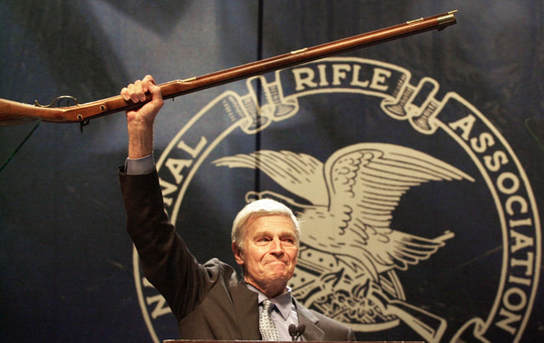
Former NRA President Charlton Heston in his "from my cold, dead hands" pose (AP Photo/Ric Field). Bowie adopts a similar pose with his guitar in the "Valentine's Day" video.
Much of this comes down to the fact that many of our politicians do a better job of respecting the whims of special interest groups than they do at enacting the will of their constituents. Nowhere was the power of the National Rifle Association more evident than in Georgia, where legislators killed a 40-million dollar tax break on jet fuel for Delta Airlines after the company responded to MSD students by ending its discount program for the NRA. Delta is the largest private employer in the state, yet Republican Lt. Gov. / gubernatorial candidate Casey Cagle promised that, if elected, he would kill any tax break for Delta unless the company fully reinstates its relationship with the NRA. USA Today has since revealed that only thirteen NRA members have ever used this discount (JUST THIRTEEN!). Yet Cagle and other Georgia politicians are willing to leverage it against the economic well-being of the 33,000 Georgians Delta employs. It’s pretty clear who politicians in Georgia really represent.
So here we are, at a crossroads yet again (see Columbine, Virginia Tech, Newtown, Aurora, Las Vegas). But this time it’s different. The children in Parkland have turned to face what makes America seem so strange to the rest of the world, and they’re doing it with the kind of grit and resolve that some adults find infuriating and that I - and many others - find marvelously inspiring. Next year, I’ll gather more gifts for the people I love while many of the people in Parkland will struggle to reconcile what happened on February 14, 2018 with what Valentine’s Day looks like for everyone else. But today, MSD students aren’t thinking about carnations and candy. They are continuing to challenge officials (both elected and appointed), and they’re mobilizing. On March 24th, I plan on standing with them in my community, at the March for Our Lives in Boston, so that in the future, the phrases “gun control” and “school safety” never have to share the same space again.
To find a March for Our Lives event near you, click HERE.
To find a March for Our Lives event near you, click HERE.
- Published on
Two-thousand, two hundred and forty-six dollars.
That’s how much the man sitting next to me at the Immigration Forum had in his Citibank account. I know this, not because I’m a stalker (I’m nowhere near that stealthy) but because this guy was a careless, close-phone-holder.
And he was short.
Plus, he slouched.
All these factors, meant that it only took a slight left turn of my head – which happened often as I sought to give the forum’s speakers my attention – to see what drew close-phone-holder’s attention to his phablet and away from the forum.
In addition to his bank balance (which he checked at least a dozen times over the course of the two hour meeting), there was the text to an associate about how enjoyable drinks were at B-Dubs, queries about what older men should wear to clubs in Vegas, and a search for Miracle Ear hearing aids – which made sense given all of the “Huh?”s and “What?”s he loudly sent his son’s way during the forum.
Or maybe this man, who had the appearance of a just stopping off for a gallon of milk after a long day at the office – tailored shirt unbuttoned at the collar, tie loosened, sleeves rolled up – had no intention of listening in the first place? This became clear to me as the meeting went on. No, he was here to support his boy, who was the more disrespectfully engaged of the two, and to check his phone.
Junior, who appeared to be in his early twenties, beat-boxed his way through the meeting, scoffing and grunting at any mention of immigration’s historic role in weaving together the fabric of his community. His disapproving whispers scratch-scratch-scratched against the backbeat of the panelist’s comments, dismissing each person’s claims before they were finished making them.
Remember, I could see everything that danced across the screen of close-phone-holder’s phablet, including the texts his son was so feverishly sending him between gasps and guffaws. If these missives were to be believed, then junior knew more about the law than the chief of police AND the city’s solicitor. He knew more about immigration’s impact on the community than a professor who made the subject his specialty at the local university. The minister whose congregation dealt with immigrants on a daily basis? Useless, as was the vastly unqualified school district official. And – surely – this young man’s perspective as a lifelong city resident and ‘Murican citizen was more cogent to the conversation than a fellow resident’s who – while also a U.S. citizen – was not BORN here. When dad validated this claim with the assertion that junior had the wrong skin color, I snapped.
I turned towards father and son and, in my angriest, most condescending whisper, told them that I could see everything on dad’s screen. Why, I demanded, was he looking at his bank account so often?! No, showing off a little chest hair was NOT a good look for ANYONE, let alone someone his age; and – most importantly – can you hear me okay, because I’m trying to tell you how rude and disrespectful you are?
I had my say and I left my seat to take a walk.
Out in the hall, away from my wife, the crowd, one of my bosses who shared the stage, and those two trolls whose behavior so incensed me, I did what most people would do: I took out my phone, opened my search engine, and I started to Hyde. I knew junior’s name – it was on the screen right in front of me for more than half the meeting – and my joints popped and swelled as my now knobby fingers ran across my phone.
I trolled them. Blatantly.
I learned that junior survived a childhood illness that required two organ transplants. I discovered that as a teenager he had been arrested for driving around town and shooting kids with a pellet gun. Dad, on the other hand, was a local business owner. You could find his commercials, touting his years of dedication and service to the community he called home, online, his outsized personality filling the screen. How, I wondered, would he treat the woman he and his son mocked from behind their phones if she were to ever walk into his office looking for car insurance?
I learned that they had relatively open social media profiles, and I was tempted to call them out in a Facebook post – to challenge any of my friends who may have business with dad’s company to rethink who they paid their premiums to.
I looked around some more.
Despite their behavior at the forum, both father and son seemed relatively apolitical online. Junior's posts were typical for a college student who was looking to define himself by who he wanted to become as opposed to who he had been in high school. Look! I'm witty and ironic. I read things. I'm not the village idiot. I imagine my profile would've looked the same had Facebook been (ahem) around when I started college.
Dad's page reflected an older man's desire to embrace technology in a way that told the rest of the world, "No, I'm not too old for this!” He had many pictures, a few memes, and some general, emoji free status updates, with the occasional awkward accidental "message" that was really meant for one person and not his public wall. I saw no evidence online of the people they were sitting next to me. They had a lot friends. Tons of family. They seemed decent. They were loved.
I put my phone to sleep and went back to my seat. I was still mad, but not just at them. There was a bit of a stink on me. How do you reconcile and confront the shit that people do without becoming shitty yourself? This question followed me back to my seat.
The rest of the meeting was quiet, but I still had trouble staying focused on the speakers. When things drew to a close, a woman sitting in front of us – who wore the trappings of a Buddhist and had obviously heard the earlier commotion – turned to junior with a warm, radiant smile and asked, “Did you get your questions answered?” Dad was already moving to leave, but junior paused, stopped cold, really. He wasn’t expecting this. As my wife and I got up to leave, he and the Buddhist were talking politely.
That’s how much the man sitting next to me at the Immigration Forum had in his Citibank account. I know this, not because I’m a stalker (I’m nowhere near that stealthy) but because this guy was a careless, close-phone-holder.
And he was short.
Plus, he slouched.
All these factors, meant that it only took a slight left turn of my head – which happened often as I sought to give the forum’s speakers my attention – to see what drew close-phone-holder’s attention to his phablet and away from the forum.
In addition to his bank balance (which he checked at least a dozen times over the course of the two hour meeting), there was the text to an associate about how enjoyable drinks were at B-Dubs, queries about what older men should wear to clubs in Vegas, and a search for Miracle Ear hearing aids – which made sense given all of the “Huh?”s and “What?”s he loudly sent his son’s way during the forum.
Or maybe this man, who had the appearance of a just stopping off for a gallon of milk after a long day at the office – tailored shirt unbuttoned at the collar, tie loosened, sleeves rolled up – had no intention of listening in the first place? This became clear to me as the meeting went on. No, he was here to support his boy, who was the more disrespectfully engaged of the two, and to check his phone.
Junior, who appeared to be in his early twenties, beat-boxed his way through the meeting, scoffing and grunting at any mention of immigration’s historic role in weaving together the fabric of his community. His disapproving whispers scratch-scratch-scratched against the backbeat of the panelist’s comments, dismissing each person’s claims before they were finished making them.
Remember, I could see everything that danced across the screen of close-phone-holder’s phablet, including the texts his son was so feverishly sending him between gasps and guffaws. If these missives were to be believed, then junior knew more about the law than the chief of police AND the city’s solicitor. He knew more about immigration’s impact on the community than a professor who made the subject his specialty at the local university. The minister whose congregation dealt with immigrants on a daily basis? Useless, as was the vastly unqualified school district official. And – surely – this young man’s perspective as a lifelong city resident and ‘Murican citizen was more cogent to the conversation than a fellow resident’s who – while also a U.S. citizen – was not BORN here. When dad validated this claim with the assertion that junior had the wrong skin color, I snapped.
I turned towards father and son and, in my angriest, most condescending whisper, told them that I could see everything on dad’s screen. Why, I demanded, was he looking at his bank account so often?! No, showing off a little chest hair was NOT a good look for ANYONE, let alone someone his age; and – most importantly – can you hear me okay, because I’m trying to tell you how rude and disrespectful you are?
I had my say and I left my seat to take a walk.
Out in the hall, away from my wife, the crowd, one of my bosses who shared the stage, and those two trolls whose behavior so incensed me, I did what most people would do: I took out my phone, opened my search engine, and I started to Hyde. I knew junior’s name – it was on the screen right in front of me for more than half the meeting – and my joints popped and swelled as my now knobby fingers ran across my phone.
I trolled them. Blatantly.
I learned that junior survived a childhood illness that required two organ transplants. I discovered that as a teenager he had been arrested for driving around town and shooting kids with a pellet gun. Dad, on the other hand, was a local business owner. You could find his commercials, touting his years of dedication and service to the community he called home, online, his outsized personality filling the screen. How, I wondered, would he treat the woman he and his son mocked from behind their phones if she were to ever walk into his office looking for car insurance?
I learned that they had relatively open social media profiles, and I was tempted to call them out in a Facebook post – to challenge any of my friends who may have business with dad’s company to rethink who they paid their premiums to.
I looked around some more.
Despite their behavior at the forum, both father and son seemed relatively apolitical online. Junior's posts were typical for a college student who was looking to define himself by who he wanted to become as opposed to who he had been in high school. Look! I'm witty and ironic. I read things. I'm not the village idiot. I imagine my profile would've looked the same had Facebook been (ahem) around when I started college.
Dad's page reflected an older man's desire to embrace technology in a way that told the rest of the world, "No, I'm not too old for this!” He had many pictures, a few memes, and some general, emoji free status updates, with the occasional awkward accidental "message" that was really meant for one person and not his public wall. I saw no evidence online of the people they were sitting next to me. They had a lot friends. Tons of family. They seemed decent. They were loved.
I put my phone to sleep and went back to my seat. I was still mad, but not just at them. There was a bit of a stink on me. How do you reconcile and confront the shit that people do without becoming shitty yourself? This question followed me back to my seat.
The rest of the meeting was quiet, but I still had trouble staying focused on the speakers. When things drew to a close, a woman sitting in front of us – who wore the trappings of a Buddhist and had obviously heard the earlier commotion – turned to junior with a warm, radiant smile and asked, “Did you get your questions answered?” Dad was already moving to leave, but junior paused, stopped cold, really. He wasn’t expecting this. As my wife and I got up to leave, he and the Buddhist were talking politely.
- Published on
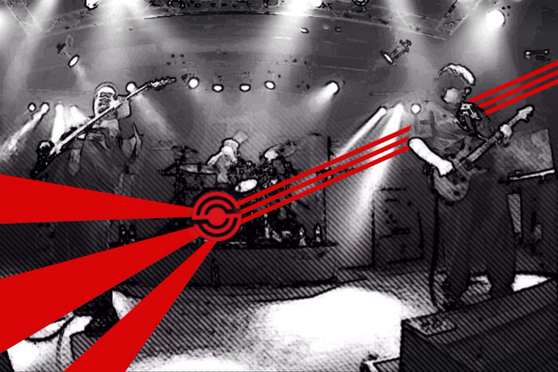
Original photo by Mozzchopz Photography
By Tom Guzzio.
Modern audiences will never hear Buddy Bolden, the cornetist considered to be the founding father of the first truly American musical form. There are no known recordings of his work. Despite the far reach of Bolden’s influence on artists like Louis Armstrong and Wynton Marsalis, the sound he created with his instrument – his musical fingerprint – is left to our imaginations, his tone a casualty of Bolden being too far ahead of his time.
This is just one of the many wrongs that litter the history of music, along with the fact that Sammy Davis Jr. couldn’t stay at many of the hotels he performed in, or with A Taste of Honey beating out Elvis Costello for Best New Artist at the 1978 Grammy Awards (hell, let’s just throw the Grammys as a concept in as a collective wrong).
Many would argue that the way popular music gets created today is another wrong, with songs written by committee for marginally talented “artists” whose looks are as important as their voices, if not more so.
But I disagree. The same technology that allows marginal vocalists to be auto-tuned into “artists” has also given legitimate musicians a platform previously unavailable when the recording industry held all the cards. Yes, there still exists a vast corporate music machine that vacuums up cash for a handful of Clive Davis wannabees. But there’s also a vibrant, independent industry outside of the industry, one that has embraced artists and musicians who can’t dance better than they sing, but who can create well-crafted songs that deserve to be heard, and are enjoyed when they are.
This is the place where The Solid Suns live.
There’s this idea that our tastes literally and figuratively mellow with age, and while I find the range of music I appreciate expanding (and, in some cases, getting softer), there’s still something about loud, ossicle-rattling rock and roll that never gets old, no matter how much I do. And while it may never crack the Billboard 200, Ungodly Hour – the latest album from the Las Vegas trio – makes my stereocillia stand up and shake, shake, shake, and that’s a damn good thing.
This is just one of the many wrongs that litter the history of music, along with the fact that Sammy Davis Jr. couldn’t stay at many of the hotels he performed in, or with A Taste of Honey beating out Elvis Costello for Best New Artist at the 1978 Grammy Awards (hell, let’s just throw the Grammys as a concept in as a collective wrong).
Many would argue that the way popular music gets created today is another wrong, with songs written by committee for marginally talented “artists” whose looks are as important as their voices, if not more so.
But I disagree. The same technology that allows marginal vocalists to be auto-tuned into “artists” has also given legitimate musicians a platform previously unavailable when the recording industry held all the cards. Yes, there still exists a vast corporate music machine that vacuums up cash for a handful of Clive Davis wannabees. But there’s also a vibrant, independent industry outside of the industry, one that has embraced artists and musicians who can’t dance better than they sing, but who can create well-crafted songs that deserve to be heard, and are enjoyed when they are.
This is the place where The Solid Suns live.
There’s this idea that our tastes literally and figuratively mellow with age, and while I find the range of music I appreciate expanding (and, in some cases, getting softer), there’s still something about loud, ossicle-rattling rock and roll that never gets old, no matter how much I do. And while it may never crack the Billboard 200, Ungodly Hour – the latest album from the Las Vegas trio – makes my stereocillia stand up and shake, shake, shake, and that’s a damn good thing.
The album is sonically alluring from the start. “Buttons + Strings,” the album’s opener is a vapor trail of driving funk with a slinky pop flavor courtesy of Jim Campbell’s excellent bass playing. Jon Gamboa’s vocals groove in and out of Campbell’s wake, a smooth falsetto croon that falls a few notches during the menacing chorus: “Come on back! I’ll tear you to pieces...”
This gives way to the whiplash inducing “Existential Queen,” which is driven by Brian Keen’s relentless drumming and it’s marriage with Campbell’s bass. The rhythmic foundation Keen and Campbell create give Gamboa’s guitar and vocals a huge sonic canvas, and he uses every inch of it until he counts us out at the end.
Next comes “Overcast” – a song that repaints the blues with shades of gray. This is a band that knows the shoulders on which they stand. “Overcast” incorporates the blues form for the modern age in a way that’s authentic and not purely imitative. It’s a field song for the suburban retail worker who, as he looks at the Kardashian fueled glow coming off his flat-screen, can’t help but feel “the sun likes to shine on everyone but me.”
"Speak Easy" follows with a riff rooted at the bottom end of the scale. It's a slow song, not quite as bluesy as "Overcast," but with a weight that you feel in your chest if you play it loud enough. It's another fine showcase for Gamboa's vocal range, and his guitar solo around the 3:30 mark is razor sharp.
The band brings more playfulness to the next track, "The Little Things" which again showcases their ability to play punch-drunk funk infused rock. It's a foot stomper that's bound to be a favorite of the band's live shows, and I challenge anyone to listen to it without bobbing their head along in time.
They go deep with "Questions." Gamboa has a rebel spirit, and it takes center stage here: "who the fuck are you to tell us what to do?" It's a question that all good rock and roll should ask at one time or another, and it places The Suns within the tradition of Josh White, Woodie Guthrie, The Clash, and Rage Against the Machine.
Gamboa turns that cynical eye on himself with "Black Matter," another percussive rocker that declares "I am the perfect liar, perfect liar, now watch and learn." It's a heavy song sonically and lyrically - one that challenges fundamental notions of belief as a motivating force. One man's righteous act is another man's senseless one; your martyr is my villain.
"Voight-Kampff" is a love song of sorts. The title alludes to Blade Runner, and the test used to distinguish humans from replicants. Are we the architects of the ones we love? Do we create unattainable expectations for those we objectify?
"Violate" begins as so many of the songs on Ungodly Hour do: with a bouncy bass line from Campbell. This band is so good at playing with and around each other, something this song illustrates as each musician's part grows around the other's like wisteria, especially around the 2:50 mark, when things breakdown only to rebuild. It's a great shift tonally.
"Remember" is a classic closer (only it isn't - wink, wink). It takes everything that's good about Ungodly Hour and draws a logical, effective musical conclusion. We will remember the song, and the album, and we will listen again. It's that simple, and hidden within it is a track whose title perfectly sums up what Ungodly Hour is about: "Heavy."
Truly. Ungodly Hour is an imaginative, finely crafted rock and roll album. So why is it part of the lead up to "The Wrong Issue?" It's because of the circumstances in which it was made.
While a lot of less talented acts get as much money and studio time as they need to record their work, Ungodly Hour was made on a shoestring. It just doesn't sound like it. It is the product of blood, sweat, and an Indiegogo campaign. There's something inherently wrong about the way major labels decide who gets their support and who doesn't. Maybe any or all of the Suns should've had roles on a Disney show when they were kids? Maybe the bassist needs to put out a sex tape, or at least accidentally tweet a dick pic to get the media attention the band's music merits and deserves?
Still, the fact that something so good can be born from a small studio in a town not known as a musical hotbed does say something positive about what's possible in music today, so long as one loves making it. And the Solid Suns love for the music they make is evident throughout Ungodly Hour. Even as so much of the music industry seems so shallow and cardboard, Ungodly Hour exists and is available for all to hear. I'm not sure if that was possible before the digital age. And that makes me hopeful for the Suns' long term prospects.
This gives way to the whiplash inducing “Existential Queen,” which is driven by Brian Keen’s relentless drumming and it’s marriage with Campbell’s bass. The rhythmic foundation Keen and Campbell create give Gamboa’s guitar and vocals a huge sonic canvas, and he uses every inch of it until he counts us out at the end.
Next comes “Overcast” – a song that repaints the blues with shades of gray. This is a band that knows the shoulders on which they stand. “Overcast” incorporates the blues form for the modern age in a way that’s authentic and not purely imitative. It’s a field song for the suburban retail worker who, as he looks at the Kardashian fueled glow coming off his flat-screen, can’t help but feel “the sun likes to shine on everyone but me.”
"Speak Easy" follows with a riff rooted at the bottom end of the scale. It's a slow song, not quite as bluesy as "Overcast," but with a weight that you feel in your chest if you play it loud enough. It's another fine showcase for Gamboa's vocal range, and his guitar solo around the 3:30 mark is razor sharp.
The band brings more playfulness to the next track, "The Little Things" which again showcases their ability to play punch-drunk funk infused rock. It's a foot stomper that's bound to be a favorite of the band's live shows, and I challenge anyone to listen to it without bobbing their head along in time.
They go deep with "Questions." Gamboa has a rebel spirit, and it takes center stage here: "who the fuck are you to tell us what to do?" It's a question that all good rock and roll should ask at one time or another, and it places The Suns within the tradition of Josh White, Woodie Guthrie, The Clash, and Rage Against the Machine.
Gamboa turns that cynical eye on himself with "Black Matter," another percussive rocker that declares "I am the perfect liar, perfect liar, now watch and learn." It's a heavy song sonically and lyrically - one that challenges fundamental notions of belief as a motivating force. One man's righteous act is another man's senseless one; your martyr is my villain.
"Voight-Kampff" is a love song of sorts. The title alludes to Blade Runner, and the test used to distinguish humans from replicants. Are we the architects of the ones we love? Do we create unattainable expectations for those we objectify?
"Violate" begins as so many of the songs on Ungodly Hour do: with a bouncy bass line from Campbell. This band is so good at playing with and around each other, something this song illustrates as each musician's part grows around the other's like wisteria, especially around the 2:50 mark, when things breakdown only to rebuild. It's a great shift tonally.
"Remember" is a classic closer (only it isn't - wink, wink). It takes everything that's good about Ungodly Hour and draws a logical, effective musical conclusion. We will remember the song, and the album, and we will listen again. It's that simple, and hidden within it is a track whose title perfectly sums up what Ungodly Hour is about: "Heavy."
Truly. Ungodly Hour is an imaginative, finely crafted rock and roll album. So why is it part of the lead up to "The Wrong Issue?" It's because of the circumstances in which it was made.
While a lot of less talented acts get as much money and studio time as they need to record their work, Ungodly Hour was made on a shoestring. It just doesn't sound like it. It is the product of blood, sweat, and an Indiegogo campaign. There's something inherently wrong about the way major labels decide who gets their support and who doesn't. Maybe any or all of the Suns should've had roles on a Disney show when they were kids? Maybe the bassist needs to put out a sex tape, or at least accidentally tweet a dick pic to get the media attention the band's music merits and deserves?
Still, the fact that something so good can be born from a small studio in a town not known as a musical hotbed does say something positive about what's possible in music today, so long as one loves making it. And the Solid Suns love for the music they make is evident throughout Ungodly Hour. Even as so much of the music industry seems so shallow and cardboard, Ungodly Hour exists and is available for all to hear. I'm not sure if that was possible before the digital age. And that makes me hopeful for the Suns' long term prospects.
Get Ungodly Hour via The Solid Suns' Bandcamp page, from iTunes, Amazon, or "wherever music is sold." Additionally, the album is available as a free digital download for all veterans, active military, police, fire, and rescue workers, and teachers. Contact the band via their Facebook page for details.
- Published on
Help me out. Is there a space where sports and music meet that doesn’t wind up looking and sounding like a Looney Tune? As I moved from music to sports while prepping for the upcoming issue, I tried to find a convergence of the two topics that leaves both with some dignity, but it was just not happening. Maybe it’s because the seminal volume of sports-related music is called, Jock Jams. Maybe I needed to look a little deeper.
There are a lot of songs out there related to and / or inspired by sports, but they seem trite and trend towards novelty. I’m thinking of songs like “Basketball” by Kurtis Blow (who's a Hip-Hop legend), or “Centerfield” by John Fogerty (another legendary artist). On the other hand, songs unrelated to athletic competition often get co-opted by sports, and thereby have a second (or maybe even a first) life seemingly unrelated to their stated themes or lyrical intent.
Take “Song 2” by Brit-Pop icons Blur. Released in 1997, and originally intended as a satire of American grunge music, it’s now become a stadium staple, it’s two-syllable hook used to pump up crowds the world over, joining songs like The White Stripe’s “Seven Nation Army” and Guns N’ Roses’ “Welcome to the Jungle” as unlikely declarations of fandom.
There are a lot of songs out there related to and / or inspired by sports, but they seem trite and trend towards novelty. I’m thinking of songs like “Basketball” by Kurtis Blow (who's a Hip-Hop legend), or “Centerfield” by John Fogerty (another legendary artist). On the other hand, songs unrelated to athletic competition often get co-opted by sports, and thereby have a second (or maybe even a first) life seemingly unrelated to their stated themes or lyrical intent.
Take “Song 2” by Brit-Pop icons Blur. Released in 1997, and originally intended as a satire of American grunge music, it’s now become a stadium staple, it’s two-syllable hook used to pump up crowds the world over, joining songs like The White Stripe’s “Seven Nation Army” and Guns N’ Roses’ “Welcome to the Jungle” as unlikely declarations of fandom.
Eventually, I stumbled upon songs that, for one reason or another, have become so associated with certain teams as to transcend their original context and purpose, like the Rodgers and Hammerstein's, “You’ll Never Walk Alone,” which found life beyond Carousel – the musical it was written for – as Jerry Lewis’s telethon showpiece and also as Liverpool F.C.’s anthem. Unlike “Song 2,” one can actually establish a connection between the song and the team that adopted it. In 1963 “You’ll Never Walk Alone” became a number one single for Gerry and the Pacemakers, who hailed from Liverpool. Legend has it that Gerry Marsden – the group’s leader and vocalist – gave a copy of the song to Liverpool manager Bill Shankly, who was so moved that he insisted the song be played before home games. In reality, the song’s presence at Anfield is the result of the club’s music director simply doing his job. It was practice at the time to countdown the hits of the day prior to the start of a game. When “YNWA” topped the charts, therefore becoming the last song the stadium DJ played just before game time, LFC fans simply sang along as a show of support to the Merseybeat group. The DJ played it, the fans liked it, and it stuck – so much so that members of the team joined Gerry and the Pacemakers on stage when they performed the song on The Ed Sullivan show. The song has since become part of the team’s iconography, adorning its official crest, and watching over those who pass through Anfield’s Shankly Gates.
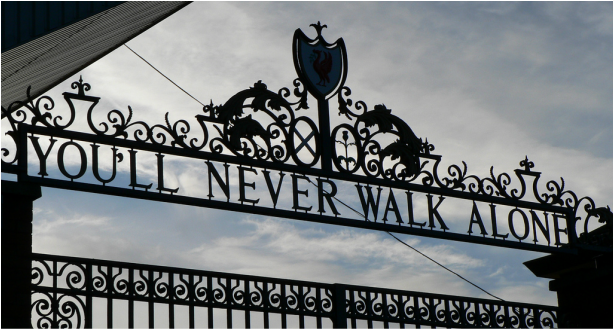
The Shankly Gates at Anfield, home of Liverpool FC. Photo by A. Nugent.
“You’ll Never Walk Alone” illustrates how when a piece becomes so associated with a particular team, there’s a tendency to want to elevate that association to the point where the origin of said song’s connection to said team becomes mythic. This is true of other music – sports connections as well, like Neil Diamond’s “Sweet Caroline,” which is played during the 8th inning intermission at every Boston Red Sox home game, and the song that is said to be the third most popular song in American history (after “The Star Spangled Banner” and “Happy Birthday to You”): “Take Me Out to the Ball Game.” These songs have come to serve the same function as hymns, in a way, as they bring people worshipping at modern day “temples” together behind a common cause, and this is a powerful thing. Liverpool fans alive at the time will note how important “You’ll Never Walk Alone” became in the wake of the Hillsborough Disaster, which saw 96 LFC fans die in the crush of an overcrowded stadium in 1989. In the end, how the songs got here isn’t important. It’s the fact that they’re here that counts. At their best, music and sport serve similar functions. They celebrate excellence. They bring people together.
- Published on
"The Faith & Doubt Issue" is weeks old, and the Philadelphia Eagles have signed Tim Tebow.
If faith is the expectation of unfulfilled promises, then Tebow, whose belief in himself is only outstripped by the doubts of his many detractors, could be due.
Or it could be that Tebow has already had his due.
Tebow had an exceptional college career with the Florida Gators, winning a Heisman Trophy and two national championships. Despite lingering doubts about his ability to make it as a quarterback in the NFL, Tebow was taken in the first round of the 2010 NFL draft by the Denver Broncos. In the 2012 playoffs, he led the Broncos to a legendary upset of the Pittsburgh Steelers in what has come to be called the “3:16 Game” because of the many parallels between some of the game’s statistics and Tebow’s faith.
Aside from this one brief, electrifying moment, Tebow’s time under center has been well-below average, and therefore short. After three teams and three years, Tebow was out of the league. Nevertheless, his time among the best is enviable. Tebow did more, and went farther than most of the kids who put on pads.
So why is Tebow back? Some suggest it’s ego.
It’s not that Tebow lacks the ability to play in the NFL, it’s that he lacks the skills to play quarterback. Tebow is an exceptionally gifted athlete. If he’d only switch to tight end or fullback, say his detractors, then he’d probably be in the midst of a long and fruitful career, instead of becoming part of Chip Kelly’s “Philadelphia Experiment.” But he’s so stubborn. For Tebow, it’s quarterback or nothing.
Which makes you wonder when faith becomes folly.
Tebow’s signing by the Eagles comes packaged in the same news cycle as the tragic sinking of a boat full of migrants off the Libyan coast, giving us two starkly different examples of how faith inculcates boldness.
Many of the 700-900 people who lost their lives crossing the Mediterranean in hopes of reaching Italy came from desperate situations in disparate places like Somalia, Eritrea, Mali, Gambia, Bangladesh, Afghanistan, Iraq and Syria. Reaching Libya, which has become the center of a booming human trafficking trade (as well as a stronghold for militants from the Islamic State) in the absence of a stable government since the fall of Ghadafi, was their “Hail-Mary.” They sought passage on an overcrowded boat of questionable seaworthiness in order to reach a land where their future was uncertain and their presence unwanted because for them, whatever was waiting on the other side of the Mediterranean’s brilliant blue had to be better than what they were leaving behind.
And there are as many as 500,000 more just like them crowding the scarred Libyan shore, dodging militias, waiting for whatever rickety boat or rubber raft may come because they believe. “I have been hearing the stories that people are dying, but me, I will cross it and I will cross it successfully,” said one migrant in a recent New York Times article. “I know that my Lord is with me. He will cross with me. I have made up my mind.”
Tebow believes, too. The faith he found on his mother’s couch as a 6-year old afraid of hell pushes him ever onward towards his brass ring of excelling at one of the most glamorous jobs in sports: “I believe in my God-given athletic ability and the coaches that have been blessed around me. I believe I can do the job as a quarterback in the NFL.”
And maybe he can, but should he want to? And, in the grand scheme of it all, should we care?
If faith is the expectation of unfulfilled promises, then Tebow, whose belief in himself is only outstripped by the doubts of his many detractors, could be due.
Or it could be that Tebow has already had his due.
Tebow had an exceptional college career with the Florida Gators, winning a Heisman Trophy and two national championships. Despite lingering doubts about his ability to make it as a quarterback in the NFL, Tebow was taken in the first round of the 2010 NFL draft by the Denver Broncos. In the 2012 playoffs, he led the Broncos to a legendary upset of the Pittsburgh Steelers in what has come to be called the “3:16 Game” because of the many parallels between some of the game’s statistics and Tebow’s faith.
Aside from this one brief, electrifying moment, Tebow’s time under center has been well-below average, and therefore short. After three teams and three years, Tebow was out of the league. Nevertheless, his time among the best is enviable. Tebow did more, and went farther than most of the kids who put on pads.
So why is Tebow back? Some suggest it’s ego.
It’s not that Tebow lacks the ability to play in the NFL, it’s that he lacks the skills to play quarterback. Tebow is an exceptionally gifted athlete. If he’d only switch to tight end or fullback, say his detractors, then he’d probably be in the midst of a long and fruitful career, instead of becoming part of Chip Kelly’s “Philadelphia Experiment.” But he’s so stubborn. For Tebow, it’s quarterback or nothing.
Which makes you wonder when faith becomes folly.
Tebow’s signing by the Eagles comes packaged in the same news cycle as the tragic sinking of a boat full of migrants off the Libyan coast, giving us two starkly different examples of how faith inculcates boldness.
Many of the 700-900 people who lost their lives crossing the Mediterranean in hopes of reaching Italy came from desperate situations in disparate places like Somalia, Eritrea, Mali, Gambia, Bangladesh, Afghanistan, Iraq and Syria. Reaching Libya, which has become the center of a booming human trafficking trade (as well as a stronghold for militants from the Islamic State) in the absence of a stable government since the fall of Ghadafi, was their “Hail-Mary.” They sought passage on an overcrowded boat of questionable seaworthiness in order to reach a land where their future was uncertain and their presence unwanted because for them, whatever was waiting on the other side of the Mediterranean’s brilliant blue had to be better than what they were leaving behind.
And there are as many as 500,000 more just like them crowding the scarred Libyan shore, dodging militias, waiting for whatever rickety boat or rubber raft may come because they believe. “I have been hearing the stories that people are dying, but me, I will cross it and I will cross it successfully,” said one migrant in a recent New York Times article. “I know that my Lord is with me. He will cross with me. I have made up my mind.”
Tebow believes, too. The faith he found on his mother’s couch as a 6-year old afraid of hell pushes him ever onward towards his brass ring of excelling at one of the most glamorous jobs in sports: “I believe in my God-given athletic ability and the coaches that have been blessed around me. I believe I can do the job as a quarterback in the NFL.”
And maybe he can, but should he want to? And, in the grand scheme of it all, should we care?

Image by the author, based on photos by Ed Clemente and Ryan Crane via WikiCommons.
- Tom
- Published on
Doubt isn't the opposite of faith; it is an element of faith. - Paul Tillich
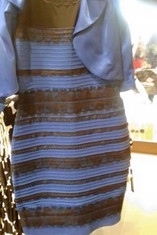
So much time and attention, airspace and bandwidth has been dedicated to one seemingly insignificant question: "what color is this dress?"
Initially, my answer was not to answer. I was one of the smarmy minority who, dammit, felt that everyone's time would be better spent on other more pressing issues, like figuring out ways to stop ISIS, or coming up with a better gluten-free pizza crust. In doing so, I took my place among the ranks of what Megan Garber called "the attention police" in a recent article about the dress phenomenon.
Still, "viral" is used to describe such things for a reason, so it didn't take long for me to offer up my opinion on the matter, mostly just to get people to stop asking (I even threatened to put it on a t-shirt). This dress is white and gold.
Only it isn't.
This dress is blue and black. My eyes let me down.
I suppose I should find some solace in the scientific explanation for why millions of people see this same dress in two very distinct ways: the brain - which is truly responsible for making meaning from what we "see" - relies on our senses as gatherers of evidence, not arbiters of truth. In other words, seeing is a guessing game. This was explored in "Colors," a recent episode of WNYC's Radiolab, which you can sample an excerpt of below:
Initially, my answer was not to answer. I was one of the smarmy minority who, dammit, felt that everyone's time would be better spent on other more pressing issues, like figuring out ways to stop ISIS, or coming up with a better gluten-free pizza crust. In doing so, I took my place among the ranks of what Megan Garber called "the attention police" in a recent article about the dress phenomenon.
Still, "viral" is used to describe such things for a reason, so it didn't take long for me to offer up my opinion on the matter, mostly just to get people to stop asking (I even threatened to put it on a t-shirt). This dress is white and gold.
Only it isn't.
This dress is blue and black. My eyes let me down.
I suppose I should find some solace in the scientific explanation for why millions of people see this same dress in two very distinct ways: the brain - which is truly responsible for making meaning from what we "see" - relies on our senses as gatherers of evidence, not arbiters of truth. In other words, seeing is a guessing game. This was explored in "Colors," a recent episode of WNYC's Radiolab, which you can sample an excerpt of below:
As "Colors" shows, there is evidence that the vast majority of ancient peoples wouldn't have identified the dress as blue either, even if that's what they saw. This is because how we identify color is a social construct born of necessity. In The Illiad, for example, Homer famously described the ocean as "wine-colored," not because "blue" water didn't exist then, but because the Greeks had no need to label anything that way. With the exception of the Egyptians, the Greeks and other ancient cultures couldn't make blue pigments given the technology they had. Since they couldn't manufacture a color - say as a dye - then there was no need to give it a name.
Since the next issue of Prodigal's Chair will be about faith and doubt, it's worth looking at what - if anything - the color of this dress can teach us about having faith or feeling doubt. Seriously.
I think that ultimately faith, like color, is constructed by the brain, based on information it picks and chooses from those unreliable narrators through which we experience the world: our senses. The Book of Hebrews says that "faith is the substance of things hoped for, the evidence of things not seen." In this verse faith is about rooting our unreliable perceptions in a tangible reality. The ancient author implies that belief lives in the distance between what the eye shows us and the meaning the brain makes of it (even if he couldn't see blue). If that's the case, then doubt is the sum of those perceptions the brain tries to leave behind whenever you make a decision or adhere to a belief.
Since the next issue of Prodigal's Chair will be about faith and doubt, it's worth looking at what - if anything - the color of this dress can teach us about having faith or feeling doubt. Seriously.
I think that ultimately faith, like color, is constructed by the brain, based on information it picks and chooses from those unreliable narrators through which we experience the world: our senses. The Book of Hebrews says that "faith is the substance of things hoped for, the evidence of things not seen." In this verse faith is about rooting our unreliable perceptions in a tangible reality. The ancient author implies that belief lives in the distance between what the eye shows us and the meaning the brain makes of it (even if he couldn't see blue). If that's the case, then doubt is the sum of those perceptions the brain tries to leave behind whenever you make a decision or adhere to a belief.

Speaking of adherence, because I know my senses are wrong, it doesn't make sense for me too hold too tightly to what my eyes still see when I look at the picture: a white and gold dress. In this instance, I have the benefit of a definitive answer. All too often, this isn't the case with other divisive issues, like religion, politics, or which region of the country makes the best barbecue. If you're like me, you do the best you can, relying on what you see and feel to answer your questions and create a way through when the answers don't come. If you're not like me, then you're probably some sort of fundamentalist who can't see past this relativistic bull-pucky and you don't care what color the dress is because it's going STRAIGHT TO HELL!!!
I'd rather take my faith with a grain of doubt.
Because it won't be long before something else comes, breaks the internet, and challenges us to choose between this or that. If we're smart - better yet - if we're compassionate, we'll gracefully excuse those who don't see what we see.
Unless, of course, it turns out the dress is really white and gold, and that the blue and black camp is simply fabricating stories like this to bolster their beliefs. Then it's time for pitch forks and torches.
- Tom
I'd rather take my faith with a grain of doubt.
Because it won't be long before something else comes, breaks the internet, and challenges us to choose between this or that. If we're smart - better yet - if we're compassionate, we'll gracefully excuse those who don't see what we see.
Unless, of course, it turns out the dress is really white and gold, and that the blue and black camp is simply fabricating stories like this to bolster their beliefs. Then it's time for pitch forks and torches.
- Tom